
Case study · Computer vision
Phantm Vision
Warehouse monitoring in which camera video never leaves the building: only events and single frames reach the cloud.
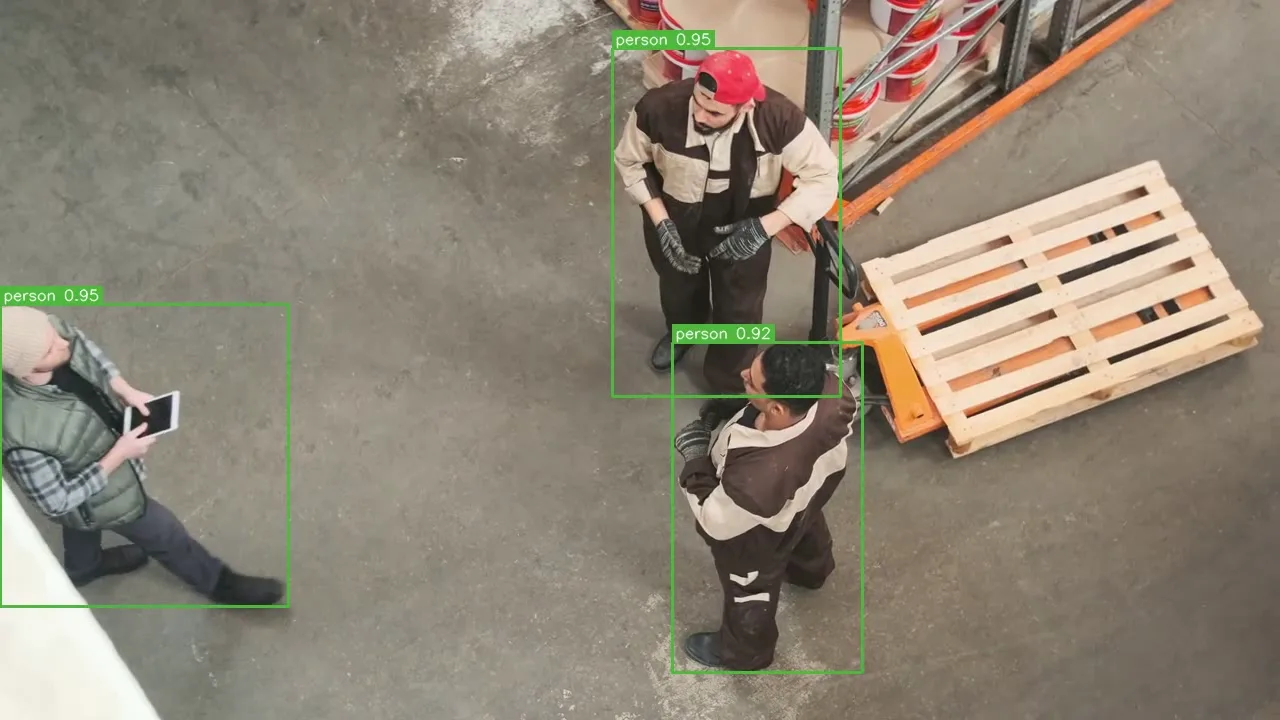
What the recording shows
The camera looks almost straight down at the floor. Three people stand at a pallet truck carrying an empty pallet: two in brown and beige workwear, the third in a green gilet with a tablet in hand. Each gets a green box labelled “person” and a confidence between 0.92 and 0.94.
Across all twelve seconds there is **not one frame without a detection**, and the average comes out at 2.94 boxes per frame with three people in shot. At this threshold the model also reported a bench and a mobile phone - those classes are not drawn, because the product does not forward them either.
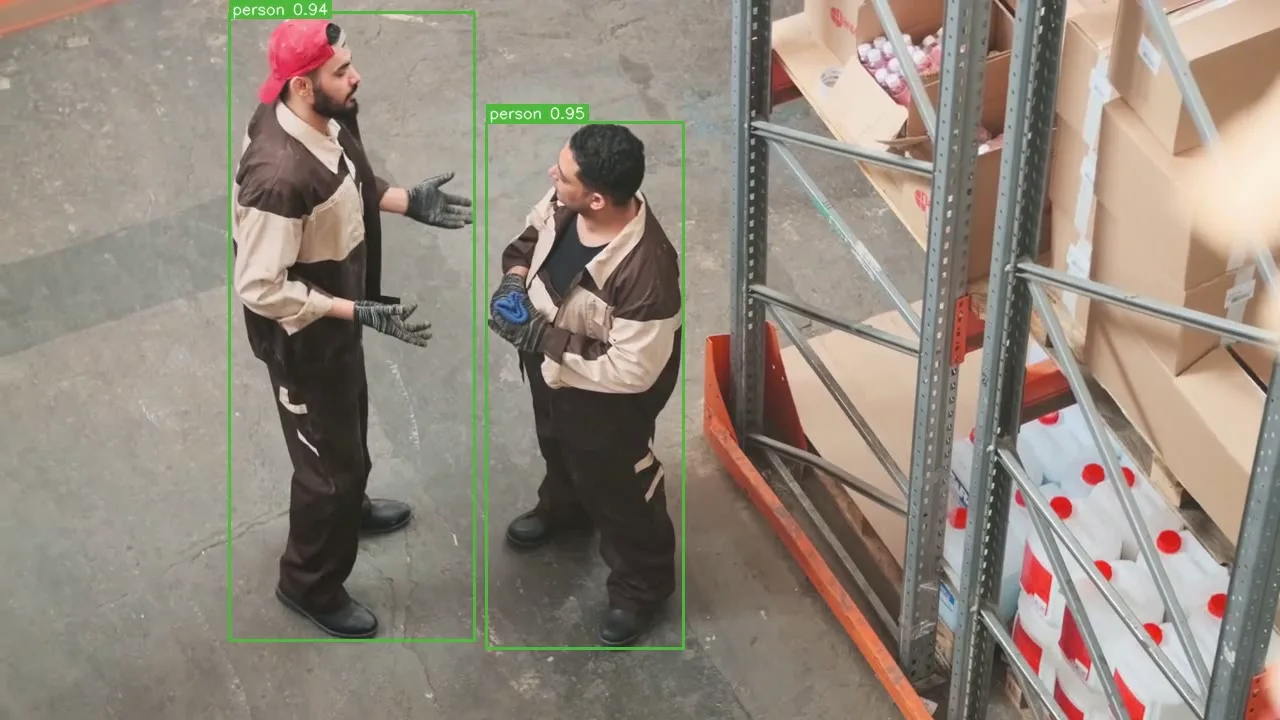
What the recording shows
A view from the top of the racking, down the aisle between pallets. Two people in workwear are talking, gesturing; a third enters at the left edge in a green gilet, phone to their ear.
Confidence runs between 0.65 and 0.96 here, and you can see what drives it: a figure turned side-on and cut by the edge of the frame gets 0.76; the same person whole and facing the camera gets 0.95. No frame comes back empty, at an average of 2.70 boxes per frame.
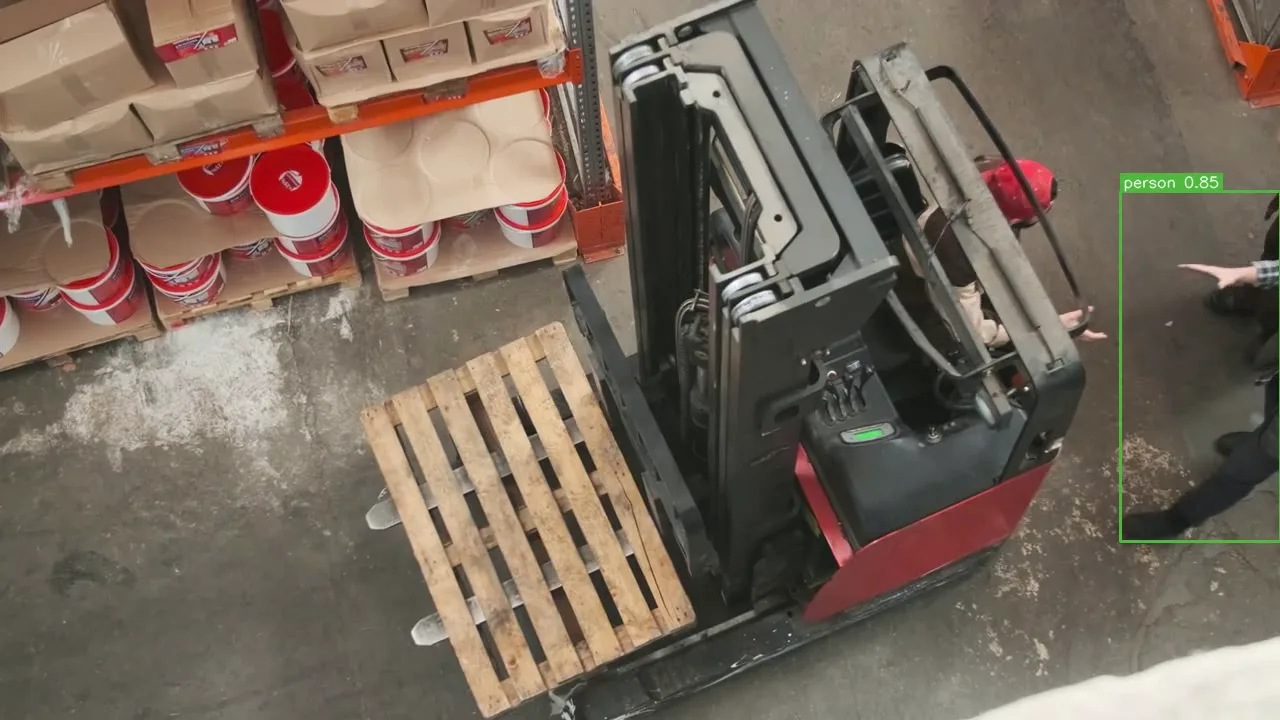
What the recording shows
Six seconds in which a forklift mast fills the middle of the frame. At the start only one person is boxed, at the right edge, with a confidence of 0.85 - the person standing behind the mast is occluded and the model does not report them. By the end there are two people at the right, 0.91 and 0.95.
This is the weakest of the four takes and that is why it is here: **seventeen percent of frames carry no detection at all.** Occlusion is the normal state of a warehouse, not the exception, and it is the reason a tracker sits in the decision layer - so that someone who disappears behind a mast for half a second does not emerge from it as a new object and a new event.
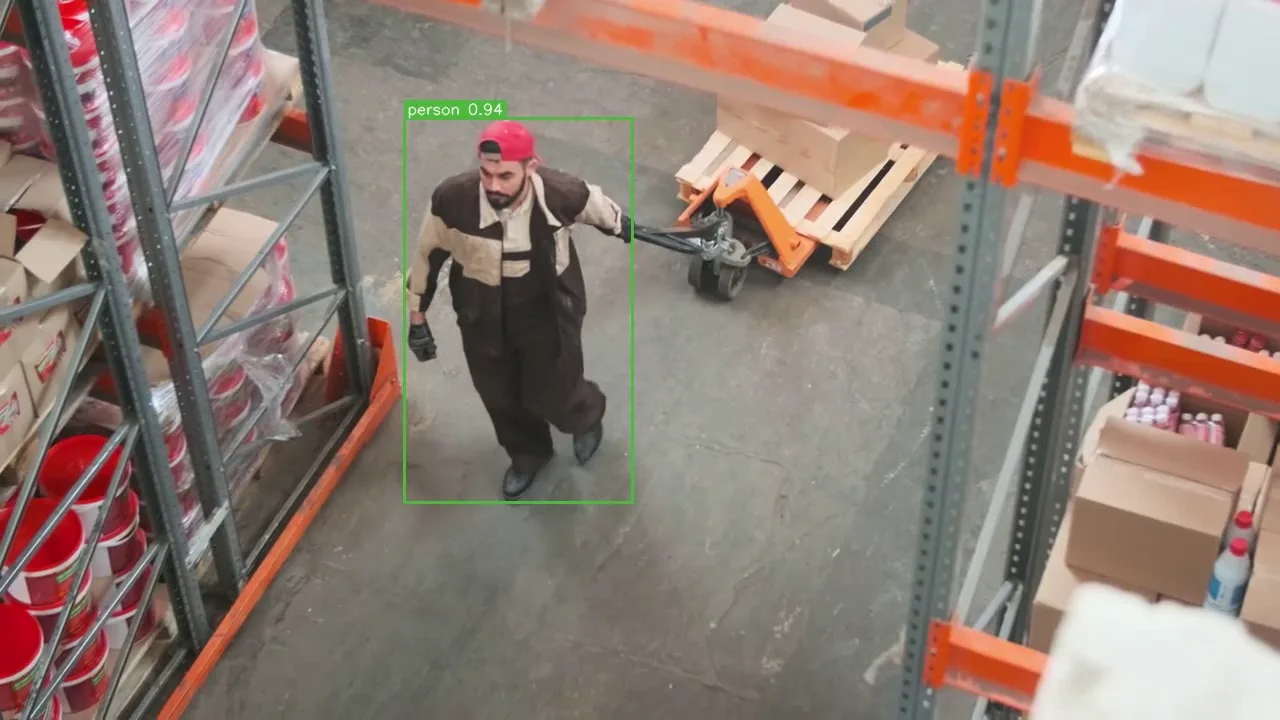
What the recording shows
A person in workwear pulls a pallet truck loaded with cartons along the racking. The box holds on them for the whole run, at a confidence of 0.83. In the second half two people stand at the load, 0.94 and 0.95.
Five percent of frames come back with nothing. At the same threshold the model also proposed a bench, a pair of skis and a cow - in a warehouse. Only the “person” class is drawn, because it is the only one this product forwards, and the rest is exactly the kind of noise the filter layer starts from.
- 01Problem
- Warehouse events need to be detected without sending entire camera streams to the cloud.
- 02Solution
- Local video analysis paired with an event dashboard. Only events and individual frames reach the cloud.
- 03Result
- A verified end-to-end flow from the camera to acknowledging an event in the dashboard. The project is not yet released.
01 · Context
Why it exists.
A small logistics company wants to know who was in the warehouse after hours. An NVR system costs too much and needs someone to run it, and cloud products ask you to send the camera feed to someone else’s server. A company like this has no IT department, but it does have a few cameras already on the walls.
Hence the rule everything else follows from: the video stays in the warehouse. And the product is not the model that recognises people, it is correct events - a system that does not wake the owner at three in the morning because the wind moved a tarpaulin.
02 · What I built
What is in it.
- A Windows app next to the cameras: a live view, a camera grid, zones and lines drawn on the image, and a night mode.
- Event filters: entering a zone, crossing a line, staying too long, moving the wrong way. They sift out the noise before anything reaches the owner.
- Working offline: when the network drops, events wait on disk and go out once it is back.
- A browser dashboard: trends, events with thumbnails to acknowledge, cameras and user roles. New events appear without a page refresh.
- A package you unzip and run: the warehouse computer needs neither Python nor a graphics card.
03 · Decisions
The decisions that mattered.
The model only looks at the image when something moves.
WhyFor most of the day nothing happens in a warehouse. A simple motion check drops about 80% of frames before they reach the model, so an ordinary computer is enough and no events are lost.
Helmet and vest recognition was withdrawn.
WhyThe model caught fewer than half the cases of a missing helmet. A safety feature that is wrong half the time is worse than none, because someone starts relying on it.
The customer’s version runs on the processor alone.
WhyThe working environment weighed over 5 GB, almost all of it support for graphics cards that warehouse computers do not have. A separate, lighter build is what made the product installable at a customer’s site at all.
04 · Status
Where it stands now.
The project is not released yet. On 23 August 2026 the first real event went the whole way: from the camera, through the filters and the cloud, to the dashboard, where it was acknowledged 16 seconds later. Installation on a clean Windows machine is still unchecked, and the agent runs as an ordinary program, so someone has to start it. Next come email alerts and reports.